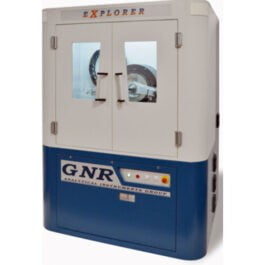
Europe 600 Benchtop X-Ray Diffractometer

Compact X-Ray Diffractometer Europe 600
- Ultra-Compact design
- Theta/2Theta and Theta/Theta outstanding goniometer
- Fail Safe Radiation Enclosure
- Fast Detector available
- Incident Beam Variable Slit
- Easy to use instrument.
- Simple installation
Europe 600 is a general-purpose benchtop diffractometer for XRD qualitative and quantitative analysis of polycrystalline materials.
Two version are available
- Theta/2Theta goniometer
- New GNR Theta/Theta goniometer.
Compact and robust design enables installation and operations in a small space. Low cost of ownership and maintenance.
With wide range of configurations and accessories such as high-speed detector, scintillation counter, secondary monochromator, spinner and multiple sample holder makes Europe 600 a perfect instrument for fast-paced routine industrial quality assurance analysis and for teaching XRD at academic level.
Operating at 600 watts enables faster analysis and outstanding overall results.
| X Ray Generator | |
| Maximum Output Power | 600 W (option: 300 W) |
| Output Stability | ≤25ppm/hr after a 2 hour warm up |
| Max Output Voltage | 40 kV (option: 30 kV) |
| Max Output Current | 15 mA (option: 10 mA) |
| Voltage Step Width | 0.1 kV |
| Current Step Width | 0.1 mA |
| Ripple | ≤1%rms at >20 kHz, 0.1%rms below 20 kHz |
| Preheat and Ramp | Automatic preheat and ramp control circuit |
| Input Voltage | 230 Vac +/-10%, 50 or 60 Hz, single phase |
| X-Ray Tube | |
| Type | Glass (option: Ceramic), Cu Anode, Fine Focus (options: any kind of X-Ray tube) |
| Focus | 0.4 x 8 mm LFF (other options available) |
| Max Output | 600 kW |
| Goniometer | |
| Configurations | Vertical Theta/2Theta geometry |
| Measuring circle diameters | 150 mm |
| Vertical Scanning Angular Range | – 5° < 2 Theta < + 145° (according to accessories) |
| Smallest selectable stepsize | 0.005° |
| Angular reproducibility | +/- 0.001° |
| Accuracy | +/- 0.01 |
| Modes of operation | Continuous scan, step scan, theta or 2 theta scan, fast scan |
| Variable Divergence slits | 0 – 4° |
| Variable Anti-Divergence slits | 0 – 4° |
| Variable Receiver slits | 0 – 4° |
| Soller slits | 2.3° |
| Detector | |
| Type | Scintillation counter Nal (options: YAP(Ce); multistrip) |
| Count rate | 10(5) cps (Nal); 2 x 10(7) cps (Yap(Ce)) |
| Case | |
| Dimensions | Width 600 mm, heigh 750 mm, depth 500 mm |
| Weight | 130 kg |
| Leakage X-rays | < 1 mSv/Year (full safety shielding according to the international guidelines) |
| Processing Unit | |
| Computer Type | Personal Computer, the latest version |
| Items controlled | X-ray generator, goniometer, sample holder, detector |
| Basic Data Processing | Polynomial least squares smoothing. Fourier smoothing. Search for Peaks (automatic and manual). Spline background subtraction. Single peak analysis (area, FWHM, centroid, background). Marquardt fit (with pseudo-Voigt and Pearson VII curves, Ka2 contribution, weighted sum of squares). Sum and multiply by a constant. Scale normalization. Zoom. Graphical windows. Overlap and comparison of diffractograms. Multiview function. Cursor scan. Creation of graphic files .BMP. ICDD-PDF2 Card Overlap. Creation of calibration curves. Analysis of unknown samples. Qualitative and quantitative phase analysis. Rietveld analysis, crystalline structural analysis, crystallite size and lattice strain, crystallinity calculation |
Data Collection Programs
GNR offers a large variety of acquisition programs for standard as well as for customized hardware configurations. List includes programs for powder and high-resolution diffractometers, retained austenite, data acquisition of stress (plane and triaxial) and thin films (XRD and GIXRD).
SAX
- Single peak analysis.
- peak treatment.
- Background subtraction, smoothing, deconvolution and peak localisation.
- Structural Analysis
- Crystallite Size
- Lattice Strain
- Reflectometry
- Quantitative Analysis.
Search and Match: MATCH!
- Rietveld refinement
- Display and compare multiple diffraction partners
- Directly view specific phases/entries
- Instant usage of additional information
- Saving of selection criteria
- Comfortable definition of background
- Improved zooming facilities
- Batch processing and Automatics.
Qualitative and quantitative phase analysis, non-ambient analysis, retained austenite quantification, structure solution and refinement, crystallite size and crystallinity calculations.
- Crystallite Size Calculation – Nanotechnology
- Phase Identification and Quantitative – Mineralogy
- Crystallinity Degree Calculation – Pharmaceutical
- Silica Dust Monitoring – Environmental
- Geology and Mineralogy / Clays
- Glass / Ceramics / Cement
- Chemicals / Petrochemicals
- Catalyst / Polymers
- Forensics
- Agricultural Sciences
- Biosciences / Environmental
- Pharmaceuticals
- Cosmetics
- Art and Archaeology