
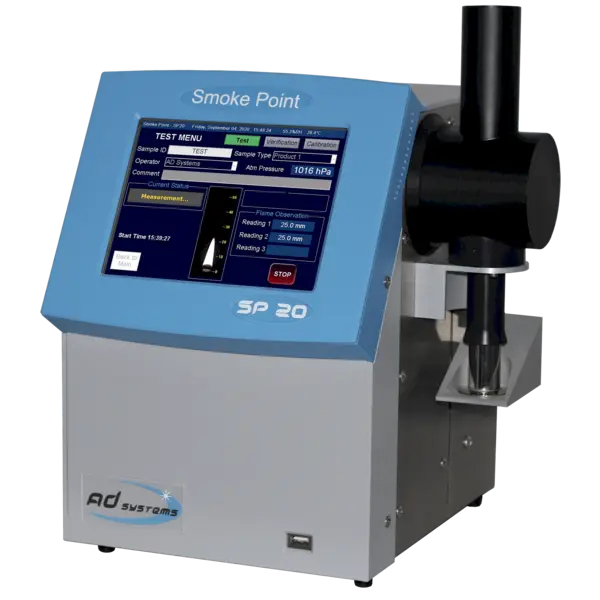
Automated Smoke Point Tester SP 20
Automatic Smoke Point Apparatus for ASTM D1322 & IP 598 SP 20
Methods: ASTM D1322, ASTM D1655, ASTM D7566, IP 598, DEF STAN 91-91, FTM 791-2107 and JIS K2537
- Automated smoke point measurement for kerosene and aviation turbine fuels
- Designed for ASTM D1322 and IP 598 smoke point testing
- Supports ASTM D1655 and ASTM D7566 applications as specified by AD Systems
- Also supports DEF STAN 91-91, FTM 791-2107 and JIS K2537
- Digital imaging technology automatically evaluates the flame shape
- Automated adjustment of flame size during measurement
- Uses the same lamp and candle principle as the manual method
- Eliminates operator subjectivity associated with visual flame assessment
- Embedded temperature, humidity and pressure sensors
- Atmospheric conditions compensation capability
- Ready for direct measurement after switching on, subject to the manufacturer’s compensation configuration
- Test duration of less than 10 minutes
- Automatic ignition and test sequence
- Five-minute flame stabilisation followed by three flame-height determinations
- Calculates and reports the mean of the three flame-height measurements
- Flame-height range of 0–50.0 mm
- 0.05 mm resolution and 0.1 mm flame-height precision
- Results reported to 0.1 mm
- 8-inch full-colour touchscreen interface
- Built-in database for up to 1,000,000 results / 14 GB
- USB, Ethernet and RS232 communication
- Results can be transferred to a LIMS through LAN
- Stores sample, operator, method, calibration and instrument information with results
- Compact 330 × 330 × 420 mm footprint
- 10 kg instrument weight
- 100/240 V, 50/60 Hz, 75 W electrical supply
The SP20 is supplied ready for operation with the apparatus, candle with wick, wick trimmer set and English instruction/user manual.
Automated Smoke Point Tester for Objective, Repeatable Measurement
The AD Systems SP20 Automated Smoke Point Tester is designed to automate smoke point measurement of kerosene and aviation turbine fuels in accordance with recognised smoke point test methods. Instead of relying on an operator to visually assess the flame, the SP20 uses a video camera, digital image processing, and automated flame adjustment to determine flame height when it reaches the specified flame shape.
This approach addresses one of the key practical limitations of manual smoke point testing: visual assessment can vary between operators, while manual testing requires considerable operator skill and time. The SP20 automates the measurement sequence and objectively determines the flame condition specified by the method.
For laboratories performing routine ASTM D1322 Smoke Point testing, the result is a more controlled and structured workflow. Once the candle has been prepared and positioned, the operator enters the sample information and starts the test. The SP20 automatically lights the candle, allows the five-minute stabilisation period and performs three flame-height determinations before calculating the mean result.
How the SP20 Automatic Smoke Point Apparatus Works
The SP20 uses a patented system based on a video camera and actuator. The camera observes the flame while the actuator adjusts its size. The flame image is digitalised and the dedicated software identifies the flame height when the flame reaches the shape described by the test method—the maximum flame height without smoke generation.
The instrument uses the same lamp and candle principle as the manual smoke point method, while digital imaging removes the operator-dependent visual assessment of flame shape.
This makes the SP20 particularly relevant where laboratories need a consistent measurement process across operators, shifts or testing locations.
ASTM D1322 Smoke Point Tester with Atmospheric Conditions Compensation
A significant feature of the SP20 is its integrated monitoring of ambient conditions. The instrument incorporates sensors for:
- Atmospheric pressure
- Relative humidity
- Temperature
The specified sensor ranges are 300–1100 hPa, 10–90% RH and 5–50°C, respectively.
The atmospheric-condition information can be used with the SP20’s atmospheric compensation capability. AD Systems states that this capability can reduce the normal calibration workload, with the instrument ready for direct sample measurement after switching on and reducing the labour normally associated with the complete calibration procedure.
For laboratories where environmental conditions can vary, the integrated measurement of temperature, pressure and humidity also provides valuable contextual information within the test record.
Fast Automated Jet Fuel Smoke Point Testing
The SP20 is designed to complete the smoke point test in less than 10 minutes.

The operator’s workflow is straightforward:
- Prepare the candle according to the applicable test method.
- Position the candle on the SP20.
- Enter the sample details.
- Start the test.
- Allow the instrument to automatically perform the test sequence.
- Review and record the calculated result.
The candle is automatically ignited, followed by the five-minute stabilisation period and three flame-height determinations. The instrument then calculates the mean value and reports the result.
The result is reported in 0.1 mm and stored in the instrument’s internal database.
Objective Smoke Point Measurement and Reduced Operator Subjectivity
Manual smoke point testing relies on the operator’s visual judgement of the flame. AD Systems identifies operator subjectivity as a limitation of the manual approach because visual flame assessment can vary from one operator to another.
The SP20 addresses this through digital imaging. The camera and software repeatedly identify the flame shape specified by the test method and determine the corresponding flame height under controlled measurement conditions.
For laboratories performing routine IP 598 Smoke Point testing, this automated approach provides a consistent measurement process while reducing dependence on individual operator judgement.
Built-In Results Database and Laboratory Traceability
The SP20 incorporates a built-in results database capable of storing up to 1,000,000 results in 14 GB. Results can be displayed, printed, saved to USB or transmitted to a LIMS through the LAN connection.
The final test report can include:
- Smoke point result
- Sample type
- Sample ID
- Date and time
- Temperature
- Atmospheric pressure
- Humidity
- Operator name
- Test method
- Calibration information
- Instrument serial number
- Software version
This provides a substantially more comprehensive test record than simply recording the final smoke point value. It also supports laboratory quality procedures by retaining information associated with both the result and instrument calibration.
Kerosene Smoke Point and Aviation Turbine Fuel Applications
Smoke point testing provides an indication of the relative smoke-producing properties of kerosene and aviation turbine fuels in a diffusion flame. The smoke point is related to the hydrocarbon composition of the fuel, with more aromatic fuel generally producing a smokier flame. A higher smoke point indicates a lower smoke-producing tendency.
The smoke point is also related quantitatively to the potential radiant heat transfer from combustion products. Because radiant heat transfer can influence the temperature of gas-turbine combustor liners and other hot-section components, smoke point provides a basis for correlating fuel characteristics with component life.
The SP20 is therefore suited to laboratories involved in:
- Jet fuel testing
- Kerosene testing
- Aviation turbine fuel testing
- Refinery laboratory testing
- Fuel supplier quality control
- Pipeline and terminal fuel testing
- Airport fuel testing
- Military fuel testing
- Research and development
- Inspection laboratories
Technical Specifications of AD Systems SP 20
| Parameter | SP20 Specification |
| Instrument | AD Systems SP20 Automated Smoke Point Tester |
| Test methods | ASTM D1322, ASTM D1655, ASTM D7566, IP 598, DEF STAN 91-91, FTM 791-2107, JIS K2537 |
| Sample types | Kerosene and aviation turbine fuels |
| Test duration | Less than 10 minutes |
| Flame height | 0–50.0 mm |
| Resolution | 0.05 mm |
| Precision | 0.1 mm flame height |
| Reported result | 0.1 mm |
| Measurement principle | Video camera, digital image processing and automated flame adjustment |
| Flame adjustment | Automatic |
| Ignition | Automatic |
| Stabilisation | 5 minutes |
| Flame determinations | Three |
| Ambient pressure sensor | 300–1100 hPa |
| Humidity sensor | 10–90% RH |
| Temperature sensor | 5–50°C |
| Atmospheric compensation | Available capability |
| Display | 8-inch full-colour touchscreen |
| Results storage | Up to 1,000,000 results / 14 GB |
| USB | 2 × USB |
| Ethernet | 1 × Ethernet |
| RS232 | 1 × RS232 |
| LIMS | LAN connection |
| Printer | Serial port; printer optional |
| Languages | English, French, Russian, Spanish, Portuguese |
| Dimensions | 330 × 330 × 420 mm |
| Dimensions | 13 × 13 × 16 inches |
| Weight | 10 kg / 22 lb |
| Electrical | 100/240 V, 50/60 Hz, 75 W |
What is the AD Systems SP20?
The SP20 is an Automated Smoke Point Tester designed for smoke point measurement of kerosene and aviation turbine fuels. It uses video imaging and automated flame adjustment to determine the flame height specified by the test method.
Why Choose the AD Systems SP20?
The SP20 combines automated flame adjustment, digital imaging, environmental sensing and automated test sequencing in a dedicated ASTM D1322/IP 598 smoke point instrument.
For laboratories moving away from subjective manual smoke point assessment, the key advantage is not simply automation. The SP20 creates a defined measurement workflow in which the flame condition is digitally assessed, three determinations are performed automatically, the mean result is calculated, and the associated sample and instrument information can be retained as part of the electronic test record.
Its combination of automated smoke point measurement, atmospheric-condition monitoring, built-in result storage and LIMS connectivity makes the SP20 particularly suited to laboratories where repeatability, operator consistency and test traceability are important.
How does the SP20 determine the smoke point?
The SP20 uses a video/CCD camera and automated flame adjustment system. The camera observes the flame and the software determines the flame height when the flame reaches the shape specified by the test method. Three flame-height determinations are made and the instrument calculates the mean result.

Does the operator need to visually determine the flame height?
No. The SP20 automates the flame observation and measurement, removing the visual subjectivity associated with the manual test.
Which standards does the SP20 support?
AD Systems SP 20 confirms to ASTM D1322, ASTM D1655, ASTM D7566, IP 598 and Def Stan 91-91, FTM 791-2107 and JIS K2537.
What fuels can be tested with the SP20?
The SP20 is designed for smoke point testing of kerosene and aviation turbine fuels (jet fuels).
How long does an SP20 smoke point test take?
The specified test duration is less than 10 minutes. The automated sequence includes a five-minute stabilisation period followed by three flame-height determinations.
What is the resolution of the SP20?
The SP20 has a specified 0.05 mm resolution and 0.1 mm flame-height precision. Results are reported to 0.1 mm.
Can the SP20 send results to a LIMS?
Yes. Results can be transmitted to a LIMS through the instrument’s LAN connection. The SP20 also provides USB and RS232 communication.
Does the SP20 record atmospheric conditions?
Yes. The instrument includes temperature, humidity and pressure sensors and can apply atmospheric conditions compensation.
How many results can the SP20 store?
The built-in database can store up to 1,000,000 results in 14 GB.
What information is included in the test report?
The report can include the smoke point result, sample type, sample ID, date and time, temperature, atmospheric pressure, humidity, operator name, test method, calibration information, instrument serial number and software version.
The SP20 Automated Smoke Point Tester is intended for laboratories and organisations requiring automated smoke point measurement of kerosene and aviation turbine fuels.
Applications include:
- Refineries — routine fuel quality and laboratory testing
- Fuel suppliers — quality verification of aviation and kerosene fuels
- Pipeline and terminals — fuel inspection and quality control
- Airports — aviation turbine fuel testing
- Military fuel testing — quality assessment of aviation fuels
- Inspection laboratories — objective and traceable smoke point measurement
- R&D laboratories — controlled smoke point evaluation
- Jet fuel testing — automated determination using the specified test methods


